
Purgatory: The Hospital of Souls Where They Learn to See
Purgatory: The Hospital of Souls Where They Learn to See
On All Saints Day, we celebrate the triumphant Church in heaven—the saints, the martyrs, the holy ones who have cleansed their souls through the blood of Christ. We ourselves are not part of the triumphant Church yet. We call ourselves the militant Church, still on our way to the promises of the Lord.
But then there’s a third dimension of the Church. We call it the Church Penitent—the Church in purgatory. What does God do with a soul that has not fully finished its healing, but also has not fully rejected God? She goes through a process of cleansing, of healing.
Dante’s Poetic Vision of Heaven, Hell, and Purgatory
Dante Alighieri, a poet from 13th century Florence, wrote three major poems reflecting on these realities—these states of the soul that we call heaven, hell, and purgatory. These three poems are a great work in philosophy and theology, and also politics, because they contain very strong political statements about the people of his time. Some people in Dante’s poem are placed in hell. Of course, some of his friends are placed in paradise, in heaven. Others, who didn’t quite make the cut, are in purgatory.
This is one of those works of art and history that you really need a good commentary to read. You don’t just sit down and read it cover to cover. It’s almost like you need a good course, even, to take them one at a time. Dante does such a beautiful job explaining these realities of the soul, these states of the soul.
Sin is the full rejection of God—the point when the soul completely identifies with its sin. Paradise is enjoying divine union with God face-to-face. And purgatory is a rehab place.
The Journey Through Hell
And so the poem starts with Dante walking down the circles of hell. He sees how these souls have completely become the object of their sin. They have no hope. They’re locked in.
He gets to the last circle—that which is reserved for Satan himself—and you would expect there will be fire and brimstone. Rather, there’s cold and chill. Dante depicts the last circle of hell as the absence of movement—the movement of love. It’s a chilling encounter.
Emerging at the Mountain of Purgatory
Picture this: After the darkness of hell, Dante emerges at dawn on an island in the Southern Hemisphere. Before him rises a great mountain—a mountain made not out of geology but out of grace. This mountain is divided into seven terraces, each one depicting one of the seven mortal sins.
This is the Mountain of Purgatory, and there’s suffering in this mountain. But it’s different than the suffering we encountered in hell, in Dante’s vision.
Hope: The Defining Mark of Purgatory
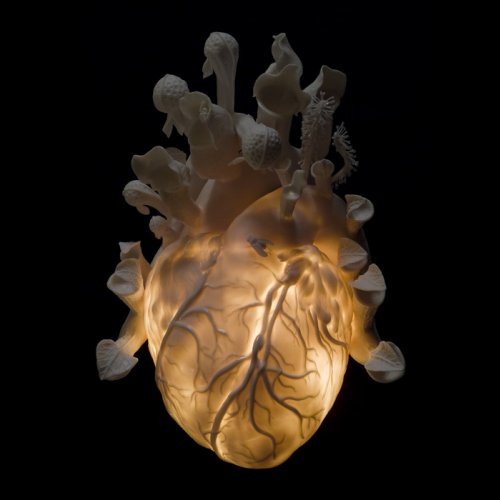
One thing that marks this mountain is the capacity to hope. See, in Dante’s mind, in his poem, purgatory is not a penal colony where individuals are paying their debts to God, and until your debts are repaid, then you may proceed. Rather, for Dante, purgatory operates as a therapeutic community. Purgatory is a hospital.
A place where the soul relearns to desire its truer love. A place where the work of God’s mercy is finalized, is completed, when love finally becomes stronger than fear.
But in order to understand why we need to be healed, we need to understand our sickness first.
David Foster Wallace: The Devastation of False Worship
David Foster Wallace was a great American poet who called himself an atheist at times, agnostic at others. In 2005, before he passed away, he delivered an almost prophetic, chilling speech—theological, even.
He says the following words:
“In the day-to-day trenches of adult life, there is actually no such thing as atheism. There is no such thing as not worshipping. Everybody worships. The only choice we get is what to worship.”
He then cataloged the devastation of how we become what we worship:
“Worship money and things, you will never have enough. Worship your body, physical pleasures and beauty, and you will always feel ugly, dying a million deaths before they finally grieve you. Worship power, you will end up feeling weak and afraid. Worship your own intellect, being smart, being seen as smart, you will end up feeling stupid, a fraud, always on the verge of being found out.”
See, what Wallace describes are not crimes that our society would condemn—to love money and work hard for it, to love beauty and showcase it. What Wallace showcases are diseases of vision, and our vision needs to be healed. We need to learn to see the deeper reality.
As St. Paul says, “Think of the things that are above, the things that are eternal, the things that do not pass” Col 3:2.
Purgatory is that place of healing that God has provided in His divine mercy. So if in hell the soul becomes what they worship, in purgatory they find that place of healing.
Learning to See: The Water That Truly Satisfies
We’re all thirsting for something, aren’t we? And in our thirst, we end up worshiping the lesser things, the lesser goods. In our thirst, we try to find satisfaction in things that just cannot deliver.
Dante takes us up the mountain of purgatory and asks this question: Can you be transformed? Can you be truly healed?
He starts one of the sections in the poem that he calls Cantos in the following way, recognizing that he’s thirsting for something, and these lesser things are not delivering:
“That natural thirst that can never be quenched, except with that water, the Samaritan woman begged to be given as a special grace.” Purgatorio, Canto XXI, lines 1–3
He saw that there was something about the water that the Samaritan woman found that compels Dante to go on that journey of the mountain, to be healed.
The Samaritan Woman’s Five Wells
Now, you remember the story well. The Samaritan woman needed to be healed. Her vision needed to be healed.
She came to the well at noon, avoiding others because nobody would go to fetch water at that time. She had had five husbands, and everybody knew about it. She had had five attempts to quench her thirst. Each husband was a well, a well she came to believing that this water would satisfy her.
- Maybe the first husband was a need for security—someone who would protect her.
- When that failed, she looked for another well, another husband. And in this one, she was looking for significance, status, or worth.
- The third one could have been passion, and that well ran dry.
- The fourth, maybe she was getting tired and just wanted companionship.
- By the fifth, she probably didn’t know what she was looking for anymore. Just desperate, terrified of the emptiness inside.
She was thirsting for something, but her vision needed to be purified. Each time she drank deeply, and each time she found herself still thirsting.
Christ Offers Living Water
And by the time she meets Jesus, there’s no one else there. Christ did not condemn her. He simply offers: “Whoever drinks of the water that I will give him will never be thirsty again.”
That living water that truly satiates your soul, the true object of her desire, what she was truly looking for but couldn’t envision after five husbands, is being revealed to her. Learning to see the living water, learning what her thirst was really for all along. She found Jesus. She learned to see. She was healed.
That’s how the Canto begins.
“That natural thirst that can never be quenched, except with that water, the Samaritan woman begged to be given as a special grace.” Purgatorio, Canto XXI, lines 1–3
Meeting Statius: The Earthquake of Healing
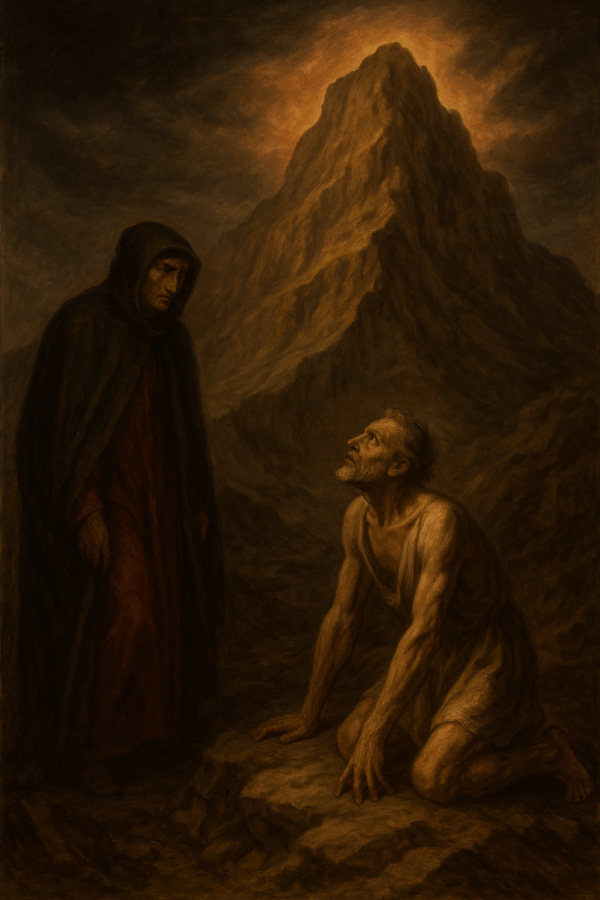
Dante’s continues his way up the mountain as he sees his own thirst. Right after he feels a powerful earthquake that shakes the entire mountain, prompting him to wonder “What could an earthquake like this mean in the mountain of Purgatory?”, on the fifth terrace, he bumps into a peculiar soul by the name of Statius (and this is when a good commentary comes in handy).
Statius was a great Roman poet, very famous, very influential. But he was giving himself into wasteful and self-indulgent behavior, living for pleasure, avarice, hoarding, clinging and holding on tightly to material goods. He was a man of faith, but he hadn’t been fully healed of this sin quite yet. And he died so.
When Dante encounters this poet, he hears him say:
“And I, who have been prostrate in this pain 500 years and more, just now felt my freed will seek a better threshold.” Purgatorio, Canto XXI, lines 67–71.
Five Hundred Years of Learning
What was happening in those 500 years? (Five hundred years is poetic language—they are outside of time, it’s not chronological years.)
In those 500 years, he learned what he could not learn any other way. Imagine it: He’s prostrated there in Mount Purgatory. The possessions he clutched that he no longer has—he sees now they were trying to fill a void they could never fill. The pleasures he chased promised a satisfaction that they could never deliver quite. The security he built? Hedged against the death that he could never avoid.
And year by year, the fog begins to lift and he begins to see a little more. Finally, he’s healed of this distortion. But only after a lot of suffering.
By Suffering What Must Be Suffered
Dante challenges the reader to consider how by suffering what must be suffered, we learn to see things more deeply.
And in this man’s suffering—Statius—he was healed to see more deeply. And something happened: The whole mountain trembled. We come to find out that that happens when a soul is fully healed. When the soul is able to see something beyond what they were committing themselves to.
Seeking a Better Threshold
Listen to the part of the poem again:
“And I who have been prostrated in this pain 500 years and more, just now felt my freed will seek a better threshold.” Purgatorio, Canto XXI, lines 67–71.
Seeking it out. A better threshold.
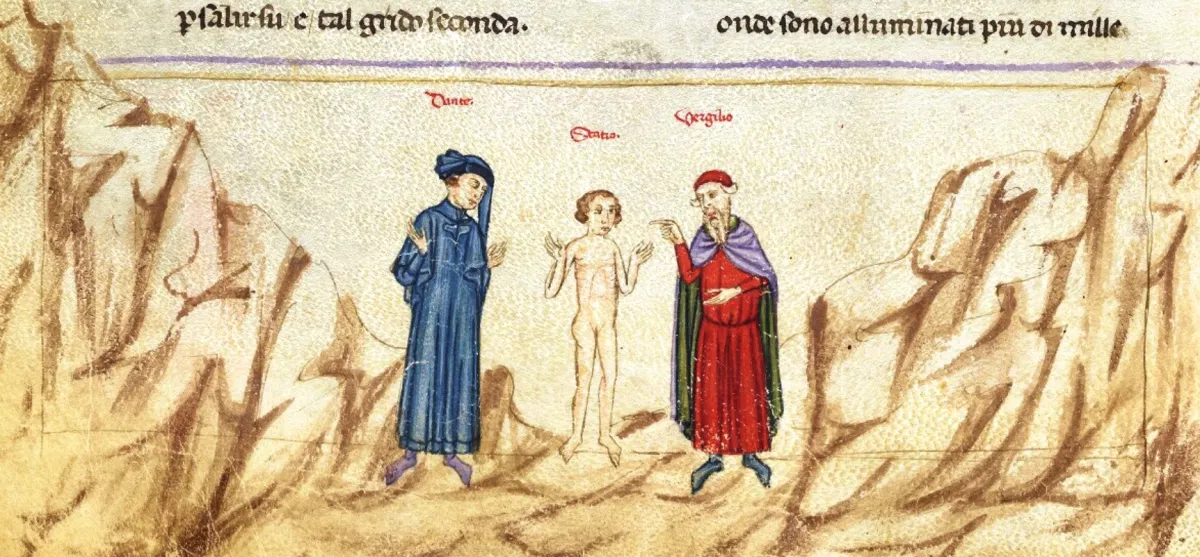
Statius Explains the Earthquake – Bodleian Library MS. Holkham misc. 48 (ca. 1368)
See, the problem, friends, is not desire itself. It’s not that the Church is telling us you shouldn’t desire money or fame. You shouldn’t desire health or wealth. The problem is not that we desire. The problem is that we don’t desire enough.
We seek, underlying our hearts, a better threshold—waters of life, a better well, something that does deliver in the end. That is the better threshold we’re all offered.
And when we find it, when we stand erect like Statius, the mountain trembles, heaven sings, the whole cosmos is transformed.
Praying for All Souls—Including Ourselves
On this All Souls Day, we pray for all those who have died, all those who find themselves in this hospital of purgatory, who find themselves being purified in this school of love, learning still to see more clearly, learning to have their wills reoriented toward a better threshold.
But brothers and sisters, we are also Statius. We too lie prostrate in our own ways. We also struggle with distorted visions, with false worship. And in our suffering, we learn to desire a better threshold.
Where Is Grace Teaching You to See?
Where in your life is grace—is God’s mercy, God’s love—now trying to teach you to see? Lean into your suffering, because there might be a lesson.
- The job loss that teaches you that career isn’t ultimate worth
- The illness teaching you that control is and was always an illusion
- The broken relationships, like the woman at the well, teaching you that no human can satisfy the infinite thirst that only God can quench
- Or the suffering of aging, teaching you that dignity never really lived in beauty
- Or the suffering of failure, teaching you that you’re loved for who you are and not what you accomplish
- Or the suffering of your pride, that you probably do not know what is best
A Prayer for Healing
So not only do we pray today for all souls in this hospital of purgatory for them to be fully healed, we pray also for ourselves, that one day we too may learn to stand erect, to see a greater threshold worth living for, even worth dying for.
Lord Jesus, reorient my gaze.
May the souls of our faithful departed, through the mercy of God, rest in peace.