

‘I did it my way’ didn’t satisfy
The Giver of Life has blessed us with biological life, at least for another day. So I invite you to take a deep breath and take stock of this beautiful gift we take for granted the vast majority of our time. He gave us biological life today to adore Him, to worship Him, to serve Him, and to delight in Him.
And it is biological life. In Greek, bios (physical, biological life) is only one slice of a far greater life: zoé, the divine, eternal life that Christ Himself came to share with us (cf. John 10:10). Today, the Lord called Himself life. He also called Himself truth.
Wired for the Quest for Truth
I don’t know about you, but since I was a kid, I have always been fascinated by discovering how things work. My parents, aunts, and uncles would gift me those “how things work” books: how plants work, how vending machines work, how this and that, explaining the ins and outs.
Did you know evolutionary biologists believe goosebumps are an evolutionary remnant from our ancestors who had thicker, longer body hair, a way of warming the body in moments of surprise? Physics studies quantum entanglement, explains string theory, and probes dark matter. Psychology, in its own quest for truth, explores our childhood wounds, our biases, the structure of desire itself, and the insecurities that secretly motivate us.
But we don’t only search for truth on a rational, scientific level. We search for it intuitively. Music reveals to us parts of ourselves that were probably unknown to us. Hearing our favorite song, watching a painting draw from old memories: these are evocative quests for truth. Beauty seduces us before we can reason about it; it tells us the truth in a pre-rational language. Nature itself preaches. The unexpected sunset on the drive home from work, the giggle of a baby, the first sip of our morning coffee: these, too, are quests for truth, aren’t they?
Faith and Science Are Not Enemies
Now, this is mostly scientific truth. Science traffics in the realm of the material, the concrete. But there is a greater truth that scientific truth serves. What does all this mean? Why is there something rather than nothing? (The philosopher Gottfried Leibniz called this “the fundamental question of metaphysics.”) What is the purpose of suffering? What is the purpose of getting out of bed in the morning?
Don’t get me wrong: the Church has never been opposed to scientific truth. The Church pursues scientific truth.
- The very proponent of the Big Bang Theory, the cosmogony of how something came out of nothing, was a Catholic priest: Fr. Georges Lemaître.
- The scientific method in the West was developed by Franciscan friar Roger Bacon.
- The very founder of modern-day genetic theory was the Augustinian monk Gregor Mendel.
- It was the Catholic Church that developed the university system and seeded the institutions we know today: hospitals, orphanages, nursing homes.
All of these stem from the Church’s quest for truth. But scientific truth is only part of it, part of a deeper quest. What is all this for?
We Are Meaning-Making Creatures
Leo Tolstoy, the celebrated Russian author, was watching a phenomenon unfold in his day: more and more men were calling themselves atheists. He could not understand it. He wrote these words:
A man may ignore the fact that he has religion, just as he may ignore the fact that he has a heart; but without religion, as without a heart, a man cannot exist.
Tolstoy understood well that we are meaning-making creatures. We don’t just accept something as brute fact. Why is there something rather than nothing? “Well, it just happened” is not a satisfying answer. Is there a reasonable explanation even for existence itself, that a Being outside of space and time gave it existence? “I AM WHO I AM” (Exodus 3:14).
And so we continue to look for truth and to fashion our meaning-making devices, and pursue our Heart’s Deepest Longing.
The False Saviors of Modern Culture
Some people fall in love with the idea of a business. They become entrepreneurs and pour decades into building something that contributes to society, telling themselves this is their search for truth. Others fall in love with academic truth: they long to leave a mark in their field of human knowledge.
Others bet everything on the amassing of capital. The belief, the meaning-making device, goes like this: “If I have enough, I’ll finally be secure.” But Jesus says: “You fool. What does it profit a man to gain the whole world and lose his life?” (cf. Mark 8:36; Matthew 16:26).
Or maybe we find meaning in developing our image and our talents until we become one of those demigods of our culture we call influencers or celebrities, promoting social justice, equality, equity. Or maybe we find meaning in health: if I do my keto diet, my intermittent fasting, my mindfulness meditation, I will finally find the harmony I so long for. Our culture has become very good at building false homelands and false gods of money, pleasure, fame, popularity, and power. And what truly feeds us meaning is something quite different.
God Is Always Speaking, Even Through Coffee
The Christian mystics tell us that God is always speaking to us. The One who is Existence itself is reaching out to us, seducing us through countless creative ways, while also respecting our freedom.
So maybe on your drive back from work, when you’re surprised by that unexpected sunset, there is a Presence calling you, saying that through that crimson sky, He bleeds for love for you.
Maybe when you are surprised by the giggle of a baby, this Presence is telling you: You are my son, you are my daughter, you are my boy, you are my girl. That is how I see you. I delight in you.
And in that first sip of morning coffee, your Father in heaven says: Today I give you new life. Today I give you breath. Today bless the day, as I bless you.
The mystics knew that God hides in plain sight, in beauty, in food, even in our enemies. The Father is always there, creatively reaching out to us. And in the fullness of time, in the fullness of love, He gave us His only Son (cf. Galatians 4:4).
The Way, Not A Way
And the Son called Himself the way: the way of your desires, your deepest longings, your craving for fullness of love and satisfaction and lasting meaning. “I am the way.”
See, friends, and this is crucial:
- Christianity is not a self-improvement program based on virtue, where you have to be pure enough or have enough faith, hope, courage, and fortitude.
- Christianity is not primarily about following a series of moral norms lest you commit sin.
- Christianity is not even, at its core, about following Sacred Scripture and Sacred Tradition, the written and spoken Word of God.
Christianity, at its very core, is the knowledge of a Person. And that Person called Himself the Way. Everything that you long for in your deepest satisfaction of desires, I am the way to the Father’s house.
He Sees You: The Lesson of Nathaniel
As I was preparing this homily, I thought of Nathaniel. Remember the story? He is brought to meet Jesus, and the first words Jesus says are: “Nathaniel, I saw you under the fig tree” (cf. John 1:47–49). And Nathaniel knew he had been by himself. Nobody could have been watching. His heart was moved to recognize in those lips the Messiah, the Son of God.
Like with Nathaniel, the Lord Jesus tells you, tells me: I see you, and I am the way.
I see the longings of your heart. I see how you’ve been wounded in your past.
I see what you hunger for.
Truly, I am the way.
I see the thirst you have for love, a love that does not betray. I see the longing you have for a beauty that does not decay. I am the way to the Father’s house.
I see your insecurities and your fear to die unsatisfied and unbloomed.
I am the way.
The Honest Question: Did “My Way” Really Satisfy?
The Lord calls us to recognize in Him divinity itself. He is not another way, like Buddha or Muhammad or the secular atheists. He is the way to the Father.
And yet so often, we look for alternative paths. “I did it my way,” as Sinatra sang, and we all hum along.
But ask yourself honestly: does that truly satisfy us to our depths? Does doing it my way fill the longings of our heart?
Perhaps there is a holier way, a perfect way, a paradoxical way. One that involves dying to self, renouncing all the things we have hinged our identity on, and discerning the Person of Jesus Christ who calls us to follow Him.
“Lord, to Whom Shall We Go?”
Think of Peter when our Lord gave His Bread of Life discourse and lost many of His followers because the teaching was too hard. Jesus turned to Peter and said, “Will you also leave me?”
And from the bottom of Peter’s heart came the most beautiful response:
“Lord, to whom shall I go? You have the words of everlasting life” (John 6:67–68).
What way am I to tread? What path am I to walk? You have the words of everlasting life.
A Closing Prayer
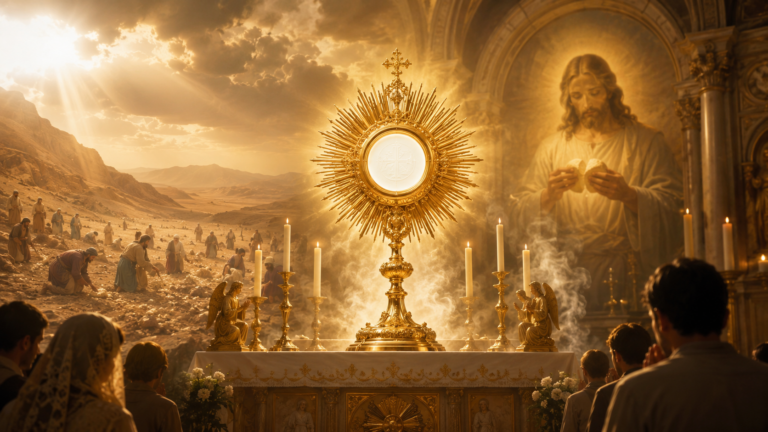
We pray that we may know Him who called Himself the way, the truth, and the life. We pray that we may discern His holy presence, especially in the sacraments, where He feeds us with His Body and Blood, that we may come to know Him dearly and profoundly and find the way to the Father’s house.
St. Peter, Prince of the Apostles, pray for us.